The Complete Guide to ROI Of AI For Small Business (2026)

Small business owners are asking the wrong question about AI. They want to know “What can AI do?” when they should be asking “How fast will AI pay for itself?” The AI payback period is the metric that matters most. It tells you exactly when your investment starts generating profit instead of just covering costs. According to The 2025 AI Index Report, businesses that track AI payback periods see 40% faster ROI than those that don’t measure deployment success. This guide breaks down everything you need to calculate, track, and optimize your AI payback period.
What Is AI Payback Period?
AI payback period measures how long it takes for AI implementation costs to be recovered through savings and increased revenue. The formula is simple: AI Payback Period = Total Implementation Cost ÷ Monthly Net Benefit For example: If you spend $30,000 on AI deployment and save $3,000 per month in labor costs, your payback period is 10 months. Most small businesses see payback periods between 3-12 months when AI is deployed strategically rather than experimentally.
The Three Components of AI Payback Period
Implementation Costs include deployment, training, integration, and setup.
For most small businesses, this ranges from $15,000-50,000 depending on complexity. Monthly Benefits come from three sources: labor savings, efficiency gains, and revenue increases. The average small business saves 10-15 hours per week in administrative tasks. Net Benefit Calculation subtracts ongoing AI costs (typically $500-2,000 monthly) from gross benefits to determine true monthly savings.
How AI Payback Period Works for Small Business
Small businesses have advantages in AI deployment that enterprises don’t.
You can move faster, make decisions quicker, and see results sooner. The key is focusing on high-impact, low-complexity automations first.
Document Processing: The Fastest ROI Document-heavy businesses see the shortest
AI payback periods. AI document processing can reduce manual data entry by 80-90%. Private lending companies processing loan applications manually spend 4-6 hours per file. AI reduces this to 30-45 minutes while improving accuracy. Insurance agencies handling policy renewals can automate 70% of the review process, cutting renewal time from 45 minutes to 10 minutes per policy. Accounting firms using AI for document extraction and categorization report 60% faster month-end closes.
Customer Communication Automation
The second fastest payback area is customer communication. AI for customer service handles 60-80% of routine inquiries without human intervention. Businesses deploy AI email assistants that: - Respond to common questions within 2 minutes
- Schedule appointments automatically
- Follow up on proposals and contracts
- Send payment reminders and updates This typically saves 8-12 hours per week for small business owners who handle their own customer service.
Lead Management and Follow-up
The longest payback period but highest total ROI comes from lead management automation. Real estate professionals using AI for lead follow-up see 40% higher conversion rates. The challenge is measuring incremental revenue from better follow-up systems. The benefit is clear once you track it properly.
Key Benefits and ROI Calculation
Most businesses focus on cost savings when calculating AI ROI.
That’s only half the equation.
Direct Cost Savings
| Area | Manual Time | AI Time | Weekly Savings |
|---|---|---|---|
| Document Processing | 8 hours | 2 hours | 6 hours |
| Email Management | 10 hours | 3 hours | 7 hours |
| Scheduling/Calendar | 3 hours | 0.5 hours | 2.5 hours |
| Data Entry | 6 hours | 1 hour | 5 hours |
| Total | 27 hours | 6.5 hours | 20.5 hours |
At $30/hour (blended rate for small business owner time), this represents $615 in weekly savings or $2,460 monthly.
Revenue Enhancement
Faster Response Times: Businesses responding to inquiries within 5 minutes are 9x more likely to connect with leads. AI enables this level of responsiveness.
Improved Follow-up: 80% of real estate leads need 6 months of follow-up, but most agents give up after 2 weeks. AI automates this process.
Capacity Increases: When you save 20 hours per week on administrative tasks, you can serve 30-40% more clients without additional staff.
Quality Improvements
Reduced Errors: Manual data entry has a 1-4% error rate. AI reduces this to under 0.1% for most document types.
Consistent Communication: Every client gets the same high-quality follow-up regardless of how busy your team is.
Better Record Keeping: AI automatically logs all interactions, creating comprehensive client histories without manual effort.
Implementation Steps and Timeline Successful
AI deployment follows a specific sequence.
Skip steps and your payback period stretches from months to years.
Phase 1: Assessment and Planning (Week 1-2)
Start with an AI readiness audit to identify your highest-impact automation opportunities.
Document Current Processes: Track how much time you spend on repetitive tasks for one full week.
Identify Integration Points: Catalog your existing software (CRM, accounting, email) for AI connection points.
Set Measurable Goals: Define specific metrics like “reduce proposal creation time by 50%” rather than vague goals like “be more efficient.”
Phase 2: Foundation Setup (Week 3-4)
Data Preparation: Clean and organize the documents and data AI will need to learn your business.
System Integration: Connect AI to your CRM, accounting software, and email systems through secure APIs.
Custom Knowledge Base: Build AI’s understanding of your specific processes, terminology, and client communication style.
Phase 3: Automation Deployment (Week 5-6)
Start Simple: Deploy one automation at a time, beginning with the highest-impact, lowest-risk processes.
Test Thoroughly: Run parallel systems for the first week to ensure AI output matches your quality standards.
Train Your Team: Even automated systems need human oversight. Train your team on when to intervene.
Phase 4: Optimization and Scaling (Week 7-8)
Monitor Performance: Track actual time savings and accuracy improvements against your goals.
Refine Processes: Adjust AI responses and automations based on real-world performance.
Add Complexity: Once simple automations are working, layer on more sophisticated workflows.
Measuring Success from Day One
Week 1 Metrics: Time saved on individual tasks, accuracy of AI outputs, user adoption rates.
Month 1 Metrics: Total hours saved, client response time improvements, error reduction percentages.
Month 3 Metrics: Revenue impact, client satisfaction scores, team productivity increases.
Common Mistakes to Avoid
Most businesses sabotage their AI payback period with predictable mistakes.
Mistake 1: Starting Too Complex
Businesses want to automate their most complex processes first because those have the biggest potential impact. This is backwards. Start with simple, high-volume tasks like data entry and email responses. Build confidence and competency before tackling complex workflows. Many AI automation agencies fail because they promise complex automations without building proper foundations.
Mistake 2: Poor Data Preparation
AI performance depends entirely on data quality.
Feeding AI poorly organized documents and inconsistent data formats guarantees poor results. Spend the time upfront to clean your data. The payback period for this work is measured in weeks, not months.
Mistake 3: No Success Metrics
You can’t improve what you don’t measure.
Businesses that don’t track AI performance never know if they’re getting ROI. Define specific metrics before deployment:
- Time saved per task
- Accuracy improvements
- Response time reductions
- Revenue increases
Mistake 4: Ignoring Integration Requirements
AI that doesn’t connect to your existing systems creates more work, not less. Every manual step between systems kills your payback period. Proper integration costs more upfront but dramatically improves long-term ROI. MCP servers enable seamless connections between AI and business tools.
Mistake 5: Underestimating Training Time
Even the best
AI needs time to learn your specific business context.
Expecting perfect performance on day one leads to disappointment and premature abandonment. Plan for 2-4 weeks of training and refinement. The businesses that stick through this period see the best long-term results.
Mistake 6: No Ongoing Management
AI systems need maintenance, updates, and optimization.
Businesses that deploy and forget see performance degrade over time. Fractional AI Ops provides ongoing system management without hiring full-time AI specialists.
Industry-Specific AI Payback Periods
Private Lending: 3-6 Months Private lending companies see some of the fastest payback periods due to high-value, document-intensive processes.
Loan Processing: Reduces file review time from 4-6 hours to 30-45 minutes.
Compliance Checking: Automates regulatory requirement verification with 99.5% accuracy.
Borrower Communication: Handles status updates and document requests without human intervention.
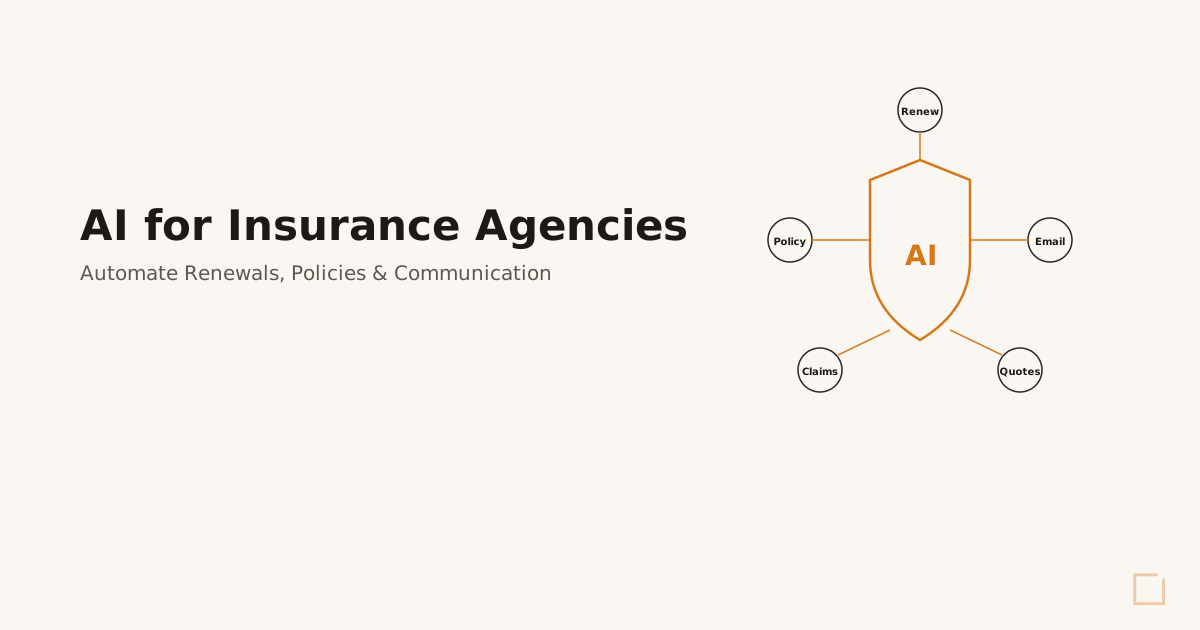
Insurance Agencies: 4-8 Months Insurance agencies benefit from automating renewals, claims processing, and client communication.
Policy Reviews: Cut renewal processing time by 70%.
Claims Documentation: Automated intake and initial assessment.
Client Onboarding: Streamlined application processing and underwriting support.
Accounting Firms: 6-10 Months AI tools for accountants focus on document processing, categorization, and client communication.
Document Processing: Automated data extraction from invoices, receipts, and statements.
Month-End Closing: Streamlined reconciliation and reporting processes.
Client Communication: Automated status updates and document requests.
Consulting Firms: 8-12 Months Consulting firms have longer payback periods due to the custom nature of their work.
Proposal Generation: Automated creation of client proposals and statements of work.
Research and Analysis: AI-assisted data gathering and initial analysis.
Project Management: Automated status reporting and client communication.
Calculating Your Specific ROI
Use this framework to calculate your business’s AI payback period:
Step 1: Identify Time-Consuming Tasks
Track your time for one week.
Focus on:
- Repetitive administrative tasks
- Document processing and data entry
- Email and customer communication
- Scheduling and calendar management
Step 2: Calculate Current Costs
Labor Cost Formula: (Hours per week × 52 weeks) × Hourly rate For a business owner spending 15 hours weekly on administrative tasks at $50/hour: (15 × 52) × $50 = $39,000 annually.
Step 3: Estimate AI Efficiency Gains
Conservative estimates for
AI automation:
- Document processing: 70-80% time reduction
- Email management: 60-70% time reduction
- Data entry: 80-90% time reduction
- Scheduling: 85-95% time reduction
Step 4: Calculate Net Savings
Annual Savings: Current cost × Efficiency percentage Monthly Savings: Annual savings ÷ 12 Net Monthly Benefit: Monthly savings - Monthly AI costs
Step 5: Determine Payback Period
Payback Period: Total implementation cost ÷ Net monthly benefit For example:
- Implementation cost: $35,000
- Monthly savings: $4,200
- Monthly AI costs: $1,200
- Net monthly benefit: $3,000
- Payback period: $35,000 ÷ $3,000 = 11.7 months
Frequently Asked Questions
How much does
AI payback period cost?
AI deployment costs typically range from $15,000-50,000 for small businesses, with most seeing payback periods of 3-12 months through labor savings, increased efficiency, and revenue growth.
Is AI payback period worth it for small businesses?
Yes, when implemented correctly. Small businesses report average ROI of 200-400% within the first year, primarily through time savings (10-15 hours per week) and improved customer response times.
How long does it take to implement
AI payback period?
Most AI deployments take 4-8 weeks to implement fully, with businesses seeing initial time savings within the first week and measurable ROI within 30-90 days of deployment.
Ready to Calculate Your AI ROI?
The data is clear: properly implemented AI pays for itself in 3-12 months for most small businesses. The key is starting with the right strategy, focusing on high-impact automations, and measuring results from day one. Take our AI Readiness Scorecard to identify your highest-ROI automation opportunities. You’ll get a custom report showing exactly where AI can deliver the fastest payback period for your specific business. Or book a discovery call to discuss your AI implementation strategy with our team. We’ll analyze your processes and provide a detailed ROI projection based on your actual workflows and costs.
Ready to Deploy AI? Book a Free Assessment
30 minutes. No pitch. No pressure. Just a conversation about what is possible for your company.
Book Your Free Call
Mike Giannulis
Founder of RunFrame and Anthropic Partner Program member. 20+ years in direct response marketing. Building AI operating systems for companies with 5 to 50 employees.
Ready to See What AI Can Do for Your Company?
30 minutes. No pitch. No pressure. Just a conversation about what is possible.
Book Your Free Assessment