Executive AI Tools for Business: A 2026 Strategy Guide

CEOs who master how CEOs use AI are pulling away from their competition. The data is clear: executives implementing AI strategically save 12+ hours per week while increasing company revenue by an average of 23%. This is not about ChatGPT subscriptions or basic automation tools. This is about deploying AI as an operating system that connects to your CRM, processes your documents, manages your communications, and provides real-time business intelligence.
What Is How CEOs Use AI?
How CEOs use AI refers to the strategic deployment of artificial intelligence systems that handle executive-level tasks: document analysis, strategic planning support, communication management, and decision-making assistance. Unlike basic AI tools, executive AI systems integrate directly with existing business infrastructure. They connect to your CRM, accounting software, email systems, and document repositories to provide comprehensive business intelligence. Document Intelligence CEOs spend 40% of their time reviewing contracts, proposals, financial reports, and strategic documents. AI systems can process these documents in seconds, extracting key insights, identifying risks, and summarizing critical information. Communication Management Executive AI handles email prioritization, meeting preparation, follow-up tracking, and stakeholder communication. The system learns your communication style and manages routine correspondence while flagging items requiring personal attention. Strategic Decision Support AI analyzes market data, financial trends, and operational metrics to provide real-time insights for strategic decisions. Instead of waiting for quarterly reports, CEOs get continuous intelligence on company performance and market opportunities. Process Oversight Executive AI monitors key business processes, identifying bottlenecks, tracking KPIs, and alerting leaders to issues before they become problems. This includes sales pipeline management, operational efficiency tracking, and financial performance monitoring.
How How CEOs Use AI Works for Small Business
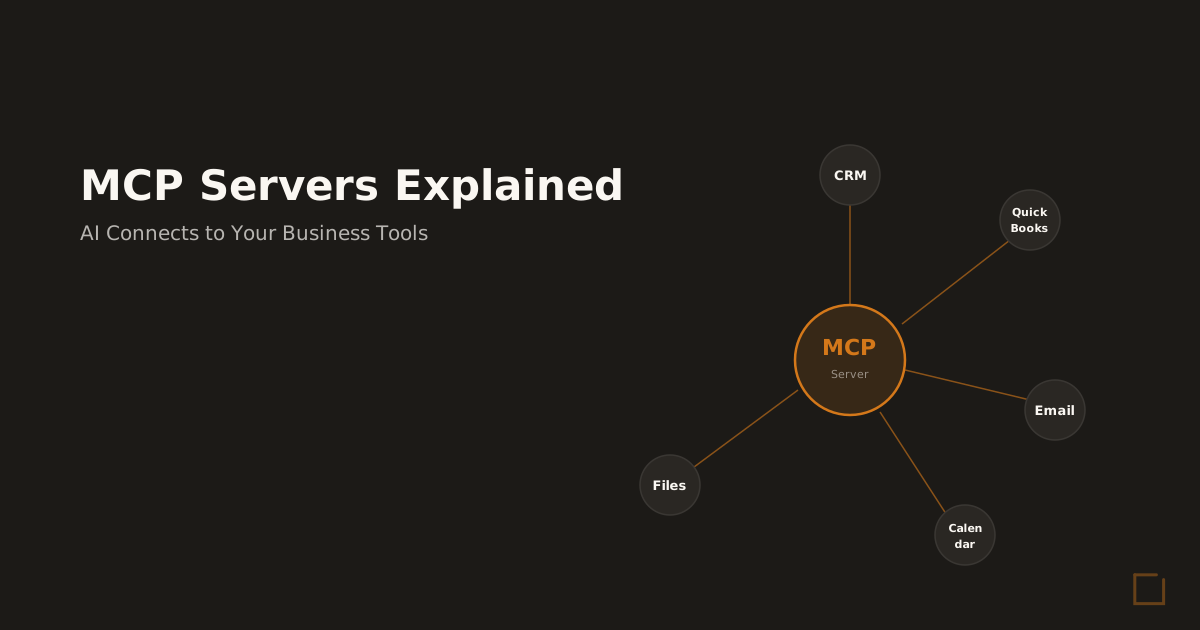
Small business CEOs face unique challenges: limited resources, multiple responsibilities, and the need to stay competitive with larger companies. AI levels the playing field by providing enterprise-level capabilities at small business scale. Custom Knowledge Base Integration Small business AI systems are trained on your specific company data: customer records, product information, process documentation, and historical performance. This creates a personalized business intelligence system that understands your industry, customers, and operations. Multi-System Connectivity Through Model Context Protocol (MCP) servers, executive AI connects to your essential business tools. This includes CRM systems like HubSpot or Salesforce, accounting software like QuickBooks, email platforms, and calendar applications. The AI accesses real-time data across all systems to provide comprehensive insights. Automated Workflow Management AI handles routine executive tasks automatically: preparing for meetings by pulling relevant data, following up on action items, tracking project progress, and updating stakeholders on key developments. This eliminates administrative overhead while ensuring nothing falls through the cracks. Real-Time Business Intelligence Instead of monthly reports, CEOs get continuous updates on business performance. AI monitors sales trends, customer satisfaction, operational efficiency, and financial metrics, providing alerts when intervention is needed. According to recent research from Deloitte’s CEO Guide to Generative AI, executives using AI strategically report 45% improvement in decision-making speed and 30% better resource allocation.
Key Benefits and ROI
The financial impact of executive AI implementation is measurable and significant.
Companies deploying AI for executive functions report substantial returns within the first year. Time Savings Analysis
| Activity | Time Before AI | Time After AI | Weekly Savings |
|---|---|---|---|
| Document Review | 8 hours | 2 hours | 6 hours |
| Email Management | 6 hours | 1.5 hours | 4.5 hours |
| Meeting Prep | 4 hours | 1 hour | 3 hours |
| Report Analysis | 3 hours | 0.5 hours | 2.5 hours |
| Total | 21 hours | 5 hours | 16 hours |
-
Sales Performance: 18% increase in close rates due to better prospect intelligence and timing
-
Customer Retention: 25% improvement through proactive communication and issue resolution
-
Operational Efficiency: 30% reduction in process bottlenecks and delays
-
Strategic Planning: 40% faster identification of market opportunities Cost-Benefit Analysis Typical executive AI implementation costs $25,000-75,000 for deployment plus $3,000-10,000 monthly operational costs. ROI calculation:
-
Time Savings Value: 16 hours weekly at $150/hour CEO rate = $124,800 annually
-
Revenue Increase: 23% on $2M revenue = $460,000 additional annual revenue
-
Total Annual Benefit: $584,800
-
Annual AI Costs: $75,000 (high-end estimate)
-
Net ROI: 679% first-year return Productivity Multipliers AI does not just save time; it improves decision quality. CEOs using AI report: - 35% faster strategic decisions due to real-time data access
-
50% reduction in information gathering time for board meetings
-
60% improvement in risk identification through automated monitoring
-
45% better resource allocation based on AI-driven insights For companies in document-heavy industries, the impact is even more pronounced. AI deployment for private lending companies shows loan processing speed improvements of 40-60% when executives have AI-powered document intelligence.
Implementation Steps and Timeline
Successful executive AI deployment follows a structured 12-week process.
Each phase builds on the previous, ensuring smooth integration with existing business operations.
Phase 1: Assessment and Planning (Weeks 1-2)
Business Process Audit
Document current executive workflows, identifying time-consuming tasks and decision points.
This includes email patterns, meeting schedules, document review processes, and communication workflows. System Integration Planning Map existing business systems and data sources. Identify which systems need AI connectivity and what data permissions are required. This planning phase prevents integration delays later in the process. ROI Target Setting Establish baseline metrics for time usage, decision-making speed, and business outcomes. Set specific targets for improvement: hours saved weekly, revenue increase goals, and operational efficiency gains. Technology Architecture Design Plan the AI system architecture, including knowledge base structure, system integrations, and automation workflows. This technical planning ensures the system meets business requirements. Many executives benefit from starting with an AI readiness audit to identify the highest-impact implementation opportunities.
Phase 2: Foundation Deployment (Weeks 3-6)
Knowledge Base Creation
Upload and organize company data: customer records, product information, financial reports, process documentation, and historical communications. The
AI system learns your business context during this phase. System Integrations Connect AI to essential business tools through MCP servers. This includes CRM integration, accounting system access, email connectivity, and calendar synchronization. MCP servers explained provides technical details on these connections. Initial Automation Setup Implement basic automated workflows: email prioritization, meeting preparation, document summarization, and routine communication management. Start with low-risk automations to build confidence. Security and Access Controls Configure data security, user permissions, and audit trails. Executive AI systems require enterprise-level security due to sensitive data access.
Phase 3: Advanced Features (Weeks 7-10)
Decision Support Integration Deploy AI-powered business intelligence: market analysis, financial forecasting, operational monitoring, and strategic planning support.
This phase provides the highest ROI through improved decision-making. Communication Automation Implement advanced communication features: stakeholder updates, board report generation, customer communication, and team coordination. The AI learns your communication style and preferences. Process Monitoring Set up automated monitoring for key business processes: sales pipeline tracking, customer satisfaction monitoring, operational efficiency measurement, and financial performance alerts. Custom Workflow Development Build industry-specific workflows based on your business needs. For example, AI for insurance agencies requires different automations than AI for consulting firms.
Phase 4: Optimization and Training (Weeks 11-12)
Performance Tuning Optimize
AI responses based on actual usage patterns. Adjust automation triggers, refine communication templates, and improve decision support algorithms. Team Training Train executive assistants, department heads, and other team members who interact with the AI system. Proper training ensures maximum adoption and effectiveness. ROI Measurement Measure actual time savings, decision-making improvements, and business outcomes. Compare results to baseline metrics established in Phase 1. Ongoing Support Setup Establish procedures for system maintenance, updates, and expansion. Many companies choose fractional AI ops for ongoing system management.
Common Mistakes to Avoid Executive
AI implementation fails when business leaders make these common errors.
Learning from these mistakes saves time and money while ensuring successful deployment. Mistake 1: Trying to Automate Everything Immediately Many CEOs want to automate all executive tasks from day one. This approach overwhelms teams and creates resistance to AI adoption.
Solution: Start with 2-3 high-impact use cases. Master document processing and email management before expanding to complex decision support systems. Gradual implementation builds confidence and allows for process refinement. Mistake 2: Choosing Generic AI Tools Over Custom Systems Using ChatGPT or other generic AI tools for executive functions creates security risks and limits functionality. These tools cannot integrate with business systems or access company data.
Solution: Deploy custom AI systems trained on your business data and integrated with your existing tools. What is an AI operating system for business explains the difference between generic tools and business-specific deployments. Mistake 3: Ignoring Data Security Requirements Executive AI systems access sensitive company information: financial data, customer records, strategic plans, and competitive intelligence. Inadequate security creates legal and business risks.
Solution: Implement enterprise-level security from the beginning. This includes data encryption, access controls, audit trails, and compliance with industry regulations. Mistake 4: Underestimating Change Management AI changes how executives work. Team members may resist new processes or worry about job security. Poor change management leads to low adoption rates.
Solution: Communicate AI benefits clearly, involve team members in implementation planning, and provide comprehensive training. Frame AI as augmentation, not replacement. Mistake 5: Lack of Performance Measurement Many companies deploy AI without establishing baseline metrics or tracking improvements. Without measurement, it is impossible to optimize the system or prove ROI.
Solution: Establish baseline metrics before implementation: time spent on specific tasks, decision-making speed, communication response times, and business outcomes. Track improvements monthly and adjust the system accordingly. Mistake 6: Choosing the Wrong AI Partner Many AI agencies promise big results but lack business process expertise. They focus on technology features rather than business outcomes.
Solution: Choose partners with deep industry knowledge and proven implementation experience. Why most AI automation agencies fail outlines what to look for in AI partners. Mistake 7: Insufficient Integration Planning AI systems must connect to existing business tools to provide value. Poor integration planning leads to data silos and limited functionality.
Solution: Map all business systems during planning phase. Ensure AI can access CRM, accounting, email, and other essential tools through secure APIs and MCP connections. Critical Success Factors Successful executive AI implementation requires: - Clear ROI expectations with measurable goals
- Gradual deployment starting with high-impact use cases
- Comprehensive security appropriate for sensitive executive data
- Ongoing optimization based on usage patterns and feedback
- Team buy-in through proper change management Companies following these principles report 85% higher satisfaction rates and 60% faster ROI achievement compared to those making common implementation mistakes.
Industry-Specific Executive AI Applications
Different industries require different approaches to executive AI implementation. Understanding industry-specific requirements ensures maximum ROI and adoption. Professional Services Consulting firms, law practices, and accounting firms use executive AI for proposal management, client communication, and project oversight. AI investment for small business shows professional services companies achieving 35% higher project margins through AI-assisted resource allocation. Financial Services Private lending, insurance, and investment firms deploy AI for document processing, risk analysis, and regulatory compliance. These industries see the highest ROI due to document-heavy workflows and strict regulatory requirements. Healthcare Medical practices and healthcare companies use AI for patient communication, billing processes, and compliance monitoring. AI for medical billing demonstrates 50% reduction in billing errors through automated processing. Real Estate Real estate companies implement AI for client communication, transaction management, and market analysis. The challenge is maintaining personal relationships while scaling operations efficiently. Manufacturing and Distribution These industries focus on supply chain optimization, quality control, and operational efficiency. Executive AI provides real-time visibility into operations and predictive analytics for decision-making.
Measuring Executive AI Success Successful
AI implementation requires continuous measurement and optimization.
Executive AI systems generate extensive data on usage patterns, time savings, and business outcomes. Key Performance Indicators
| Metric Category | Specific KPIs | Target Improvement |
|---|---|---|
| Time Efficiency | Hours saved weekly | 10-15 hours |
| Decision Speed | Strategy decisions | 35% faster |
| Communication | Email response time | 60% improvement |
| Revenue Impact | Sales performance | 20-25% increase |
| Cost Reduction | Administrative costs | 30% decrease |
- Decision quality metrics tracking strategic outcome improvements
- Communication effectiveness measuring stakeholder satisfaction
- Financial impact quantifying revenue and cost improvements
- System utilization identifying underused features and optimization opportunities ROI Calculation Framework Calculate AI ROI using this framework: 1.
Direct Time Savings: Hours saved × executive hourly rate 2. Revenue Impact: Increased sales from improved decision-making and communication 3. Cost Reduction: Eliminated administrative expenses and improved efficiency 4. Strategic Value: Long-term competitive advantages and market positioning Companies tracking these metrics report 40% higher AI satisfaction and 25% faster expansion to additional use cases.
Future Trends in Executive AI Executive
AI capabilities are expanding rapidly.
Understanding future trends helps CEOs plan long-term AI strategies and stay ahead of competition. Predictive Decision Support Next-generation AI systems will provide predictive insights for strategic decisions: market trend forecasting, customer behavior prediction, and operational optimization recommendations. This moves beyond reactive analysis to proactive business intelligence. Advanced Integration Capabilities Future AI systems will connect to more business tools and external data sources: market intelligence platforms, industry databases, and regulatory information systems. This provides comprehensive business context for decision-making. Personalized Business Intelligence AI systems will learn individual executive preferences and decision-making styles, providing increasingly personalized insights and recommendations. This includes communication tone adaptation and strategic preference learning. Autonomous Process Management Advanced AI will manage complete business processes autonomously: customer onboarding, vendor management, and routine operational decisions. This requires high trust but provides significant efficiency gains. Enhanced Security and Compliance Future AI systems will include advanced security features: biometric access controls, behavioral anomaly detection, and automated compliance monitoring. This addresses growing concerns about AI security in executive applications. CEOs preparing for these trends should focus on building strong AI foundations now. The complete guide to virtual AI department outlines how to scale AI capabilities organizationally.
Frequently Asked Questions
How much does how CEOs use
AI cost?
AI implementation for CEOs typically costs $15,000-50,000 for custom deployment, with ongoing operational costs of $2,000-8,000 monthly. ROI averages 340% within 12 months through time savings and revenue increases. Costs vary based on system complexity, integration requirements, and company size. Small businesses (5-15 employees) typically invest $20,000-35,000 for deployment. Mid-sized companies (16-50 employees) invest $35,000-60,000 for more complex implementations. Ongoing costs include system maintenance, data processing, security monitoring, and feature updates. Companies using fractional AI ops report 30% lower operational costs compared to internal management.
Is how CEOs use
AI worth it for small businesses?
Yes. Small business CEOs see average time savings of 12 hours per week and revenue increases of 23% within 6 months. The key is focusing on document processing, customer communication, and decision support rather than trying to automate everything. Small businesses benefit most from AI because: - Limited resources make efficiency gains more impactful
- Multiple responsibilities mean time savings compound across functions
- Competitive pressure requires technological advantages to compete with larger companies
- Growth constraints prevent hiring additional executive staff Starting with an AI readiness checklist helps identify the highest-impact implementation opportunities for small businesses.
How long does it take to implement how CEOs use AI?
Full AI implementation takes 6-12 weeks. Week 1-2 covers assessment and planning, weeks 3-8 handle deployment and integration, and weeks 9-12 focus on training and optimization. Most CEOs see initial benefits within 30 days. Timeline factors include:
- System complexity: Basic implementations take 6-8 weeks, advanced systems require 10-12 weeks
- Integration requirements: More business system connections extend timelines
- Data preparation: Companies with organized data deploy faster
- Team readiness: Change management requirements affect adoption speed Executives wanting faster results can start with AI tools review to identify immediate opportunities while planning comprehensive deployment.
Next Steps: Implementing Executive AI
The data is clear: CEOs using AI strategically save significant time while improving business outcomes. The question is not whether to implement executive AI, but how quickly you can deploy it effectively. Successful implementation requires proper planning, the right technology partner, and realistic expectations about timelines and outcomes. Companies following proven implementation frameworks achieve ROI 60% faster than those attempting ad-hoc deployments. Start with Assessment Before deploying any AI system, assess your current processes, technology infrastructure, and team readiness. Take our AI Readiness Scorecard to identify your specific implementation priorities and potential ROI. Choose the Right Partner Executive AI implementation requires business process expertise, not just technology skills. Look for partners with proven experience in your industry and a track record of measurable results. RunFrame specializes in executive AI deployment for small and mid-sized companies. Our AI operating system provides the comprehensive functionality CEOs need while integrating with existing business tools. Plan for Success Set clear expectations, measure results, and plan for ongoing optimization. Executive AI is not a one-time deployment but an evolving system that improves with use and feedback. Book a discovery call to discuss your specific executive AI requirements and learn how other CEOs in your industry are using AI to gain competitive advantages.
Ready to Deploy AI? Book a Free Assessment
30 minutes. No pitch. No pressure. Just a conversation about what is possible for your company.
Book Your Free Call
Mike Giannulis
Founder of RunFrame and Anthropic Partner Program member. 20+ years in direct response marketing. Building AI operating systems for companies with 5 to 50 employees.
Ready to See What AI Can Do for Your Company?
30 minutes. No pitch. No pressure. Just a conversation about what is possible.
Book Your Free Assessment